

In every generation, human beings must decide what governs their lives: impulse or intention. Today, the greatest battle for intention is not fought in physical spaces but within our attention. The modern digital environment, particularly social media, competes aggressively for our time, often fragmenting the very focus required for reflection, purpose, and spiritual growth.
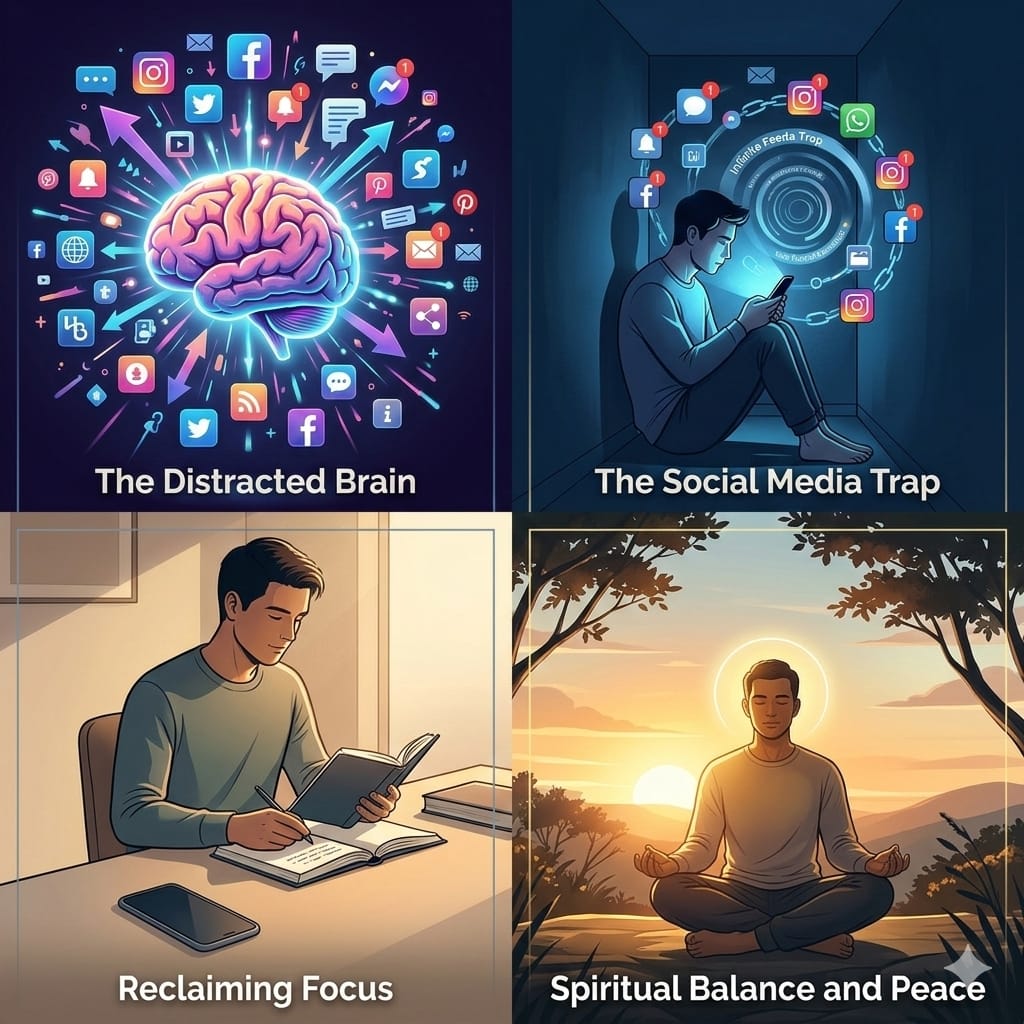
Reclaiming time is therefore more than a productivity strategy. It is a spiritual act.
Time is the most precious natural resource known. Unlike money, energy, or material possessions, time cannot be replenished once spent. Yet paradoxically, time can feel elastic or restrictive, freeing or imprisoning depending on how we perceive it and how we choose to spend it. When our attention is scattered across endless notifications, feeds, and updates, time appears to vanish. But when it is used intentionally, even a small amount can feel expansive and meaningful.
Digital discipline – consciously structuring our relationship with technology – restores our ability to steward time wisely. Digital Discipline is foundational to a purposeful life and essential for navigating the complexities of our digital age.
The Psychology of Distraction
To understand why digital discipline matters, we must first understand the psychology of distraction.
Modern social media platforms are not neutral tools. Many are intentionally designed to capture and hold attention for as long as possible. Features such as infinite scrolling, autoplay, and push notifications are engineered to encourage continuous engagement, often overriding natural stopping cues.
These systems interact directly with the brain’s reward pathways. Each like, notification, or new piece of content delivers a small release of dopamine – the neurotransmitter associated with reward and anticipation. Over time, this creates a feedback loop where the brain begins to crave the stimulation of constant novelty.
This phenomenon is increasingly referred to as “dopamine scrolling,” a pattern of compulsive content consumption driven by variable rewards—similar to the mechanisms used in gambling machines.
The consequences extend beyond wasted time. Research suggests that excessive exposure to fast-moving digital content can fracture attention spans and make it harder to focus on complex tasks such as reading, studying, or deep thinking.
In other words, the digital environment is not merely distracting—it actively reshapes how we think.
Time as Stewardship
If attention is the gateway to consciousness, then time is the field in which consciousness operates.
Across cultures and spiritual traditions, time has always been treated as something sacred. It is the vessel through which purpose is expressed, relationships are nurtured, and wisdom is cultivated.
When time is squandered through unconscious habits, something deeper is lost: the opportunity for transformation.
Most people who consider themselves spiritual, regardless of tradition, recognize the importance of a calm, balanced, and controllable environment. Such environments create the conditions for growth and self-reflection. When one is truly seeking to evolve into a better version of oneself, the surrounding atmosphere becomes critical.
Discipline and purity of environment lie at the root of nearly every spiritual practice. Many traditions encourage reducing distractions and minimizing “lower vibrational” influences such as excess consumerism, emotional waste, jealousy, and uncontrolled desire.
Peace and centeredness are the common goals.
But in the modern age, one of the greatest disruptions to that peace is the constant presence of digital noise.
The Silent Theft of Quiet Time
Social media easily and deceptively robs us of quiet time.
It fills the small spaces in our day that were once reserved for reflection: the minutes before sleep, the early morning moments of stillness, the pauses between tasks. Instead of silence, we encounter endless streams of information.
At first glance, this may seem harmless. Yet the loss of quiet reflection has profound consequences.
Reflection is where insight emerges. It is where the mind processes experiences, recalibrates emotions, and clarifies purpose. Without it, we remain in a constant state of reaction rather than intentional living.
The digital world also exposes the mind to an unprecedented volume of stimuli. With a single swipe, one can access virtually anything the human mind can imagine. Such unlimited access may appear empowering, but it is also perilous.
The mind, in its attempt to maintain equilibrium, often convinces us that we can handle this constant stimulation. We tell ourselves we are in control – that we can consume endless content without consequence.
But mounting evidence suggests otherwise.
The result is subtle but powerful: the erosion of inner peace. And without peace, spiritual health becomes difficult to sustain.
Attention and Purpose
Purpose requires attention.
Anything meaningful – learning a skill, nurturing relationships, creating art, building a community – demands sustained focus over time. When attention is fragmented, purpose becomes fragmented as well.
A distracted mind struggles to align actions with intentions. Many people report feeling trapped in cycles of digital overuse despite wanting to change their habits. Researchers describe this as a form of “psychological entrapment,” where individuals repeatedly engage in behaviors that conflict with their own goals.
This conflict creates internal tension. On one hand, there is a desire for growth and meaning. On the other, there is the immediate gratification of digital stimulation.
Reclaiming attention resolves this tension.
When attention is restored, clarity returns. And when clarity returns, purpose becomes visible again.
Structured Living Restores Clarity
One of the most powerful antidotes to digital chaos is structured living.
Structure is not restriction; it is liberation. By consciously organizing our time and environment, we reduce the number of decisions required each day and protect our attention from unnecessary distractions.
Many spiritual communities throughout history have understood this principle. Daily routines – periods for reflection, work, rest, study, and community – create rhythm and stability.
In the teachings of the Village of Peace, such discipline helps individuals “sanctify and purify” their lives.
Structure does not eliminate technology. Instead, it places technology in its proper role: a tool rather than a master.
When the environment is ordered, the mind becomes ordered as well.
Practical Steps for a Digital Reset
Reclaiming time does not require abandoning technology altogether. Instead, it requires intentional boundaries.
Here are several practical steps for restoring digital balance:
1. Track Your Time
Spend one day observing how much time you actually spend on screens. Many people are surprised by the results. Awareness is the first step toward change.
2. Create Device-Free Spaces
Designate certain environments – such as bedrooms, dining areas, or meditation spaces – as phone-free zones. This protects moments of reflection and human connection.
3. Schedule Digital Windows
Instead of constant checking, allocate specific times during the day for emails, messages, and social media.
4. Replace Passive Consumption
Use reclaimed time for activities that nourish the mind and body: reading, exercise, journaling, prayer, or meaningful conversation.
5. Rebuild Quiet Time
Start or end each day with a period of silence. Even ten minutes of reflection can restore mental clarity.
6. Curate Your Digital Environment
Unfollow accounts that create noise or negativity. Fill your feed with content that supports growth and learning.
These small adjustments gradually rewire habits and restore control over attention.
The Spiritual Power of Reclaimed Time
Digital discipline is not about rejecting modern life. It is about remembering what matters.
When we reclaim our time, we reclaim our minds. When we reclaim our minds, we reclaim our purpose.
Moments of silence return. Creativity awakens. Relationships deepen. Spiritual awareness expands.
In this sense, choosing how we spend our time becomes an act of devotion – not necessarily to a specific tradition, but to the highest potential within ourselves.
In a world that constantly demands our attention, protecting it is a form of wisdom.
And wisdom begins with one simple decision:
To live intentionally.
Reflection Questions
- How much time do you currently spend on digital platforms each day?
- Which moments of your day are most vulnerable to distraction?
- What activities bring you the greatest sense of peace or clarity?
- What would change in your life if you reclaimed just one hour per day?
- How can you design your environment to support focus, reflection, and purpose?
Share your thoughts with us in the comments section and let us know how you take control of your spiritual, physical and mental health in this digital age.
Peace and Blessings
This is an excellent piece. As an educator, I am witnessing in real time the results of young brains being rewired. It’s scary and sad to watch student struggle with simple directions and lack the curiosity and desire necessary for learning. Reclaiming our time and teaching young people the same is critical. Thank you for sharing this.